Class 21
Between Class Sessions - Prep for Day 21
Please spend around 2 hours working between class sessions, focusing on the tasks below. Use any extra time to complete KnewtonAlta assignments and/or work on Project tasks.
Pick something from your prep today that you can share with your group in class. It might be something new that you learned. It might be questions you have that are still unanswered, or a question along with what helped you eventually answer it. It might be something tricky that you solved. It might be a review topic that helped you remember something. It might be a conversation you had with AI that was helpful. You will have a chance to share this with your peers during class. Come ready to articulate your thinking and questions.
Preparation
(1) Derivative Relationships
Download this file. Then sketch the derivative of each function, using what you know about linear approximations (tangent lines) and the derivative.
Regular Reminders
Skill Practice (KA Homework)
- Complete 2 – Derivative Rules (Function Composition) - the Chain Rule assignment.
- Begin 2 – Linearization assignment.
- If you have not done so already, complete the other derivative rule assignments
- 2 – Derivative Rules (Power Function, Sum/Difference, Constant Multiple)
- 2 – Derivative Rules (Product and Quotient)
Applied Practice (Project Work)
- Continue working on Project 2 Task 1
During Class
Brain Gains
- Let \(g(y;a) = a^2+5ay-y^3\).
- Find the derivative of \(g\) with respect to \(y\) assuming \(a\) is constant.
- Find the derivative of \(g\) with respect to \(a\) assuming \(y\) is constant.
Solution
- We have \(\frac{dg}{dy} = 0+5a(1)-3y^2\) given \(a\) is constant. Soon we will write this using partial derivative notation as \(\frac{\partial g}{\partial y}=5a-3y^2\). The stylied \(d\) written as \(\partial\) means that you assume all other variables are constant.
- We have \(\frac{dg}{da} = 2a+5(1)y-0\) given \(y\) is constant. We can write this as \(\frac{\partial g}{\partial a}=2a+5y\).
- Let \(f(x) = x^2-x\). Give an equation of the linearization of \(f(x)\) at \(x=-2\).
Solution
The derivative is \(f'(x) = 2x-1\).
At \(x=-2\), this gives the slope of the linearization as \(f'(-2) = -5\). The value of the function at \(x=-2\) is \(f(-2) = 4+2 = 6\). An equation of the line that passes through the point \((-2,6)\) and has slope \(-5\) is \[y-6=(-5)(x+2)\] The above is sufficient, though we can also write this as
- \(y=6+(-5)(x+2)\) or
- \(y=-5x-4\).
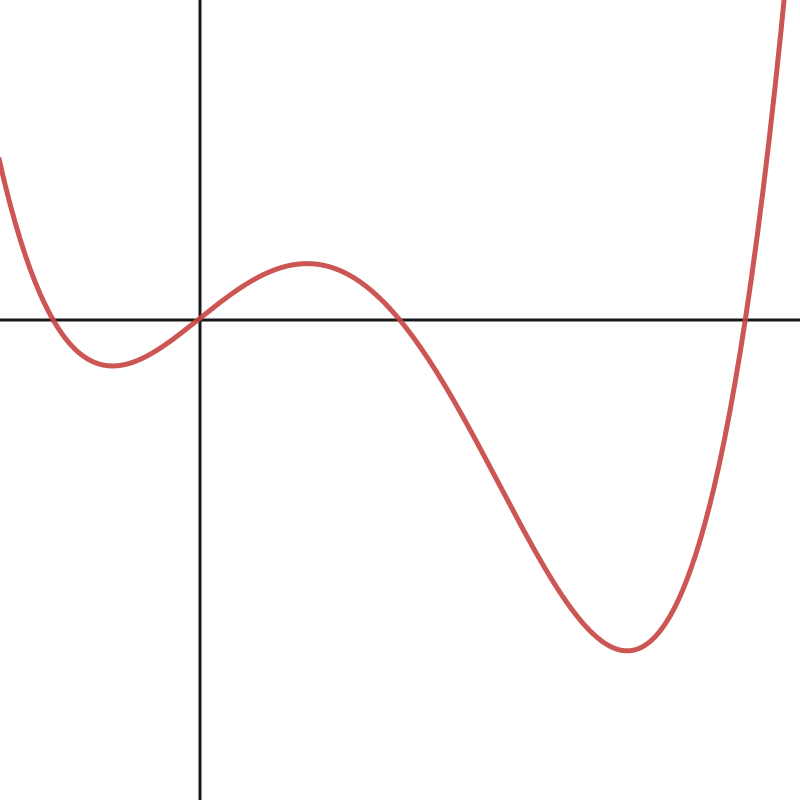
- Given the graph of a function \(h(x)\) below, draw \(h'(x)\).
Solution
Here is a solution in Desmos. Note that the derivative passes through \(y=0\) at 3 \(x\)-values. (We call places where the derivative has an output of zero, critical values). These 3 values correspond precisely to the spots on the function when the function may switch from increasing to decreasing, or vice-versa.
Group Meeting
Start by giving each person a moment to share what they chose to prepare for class. Help each other address any questions. When each person has had a chance to share, move on the other activities.
Activity - Derivative Practice with Parameters
Take turns writing your solutions on the chalk board and discussing any questions. Show your work, step-by-step, listing the rules you use at each stage. Remember to pass the chalk after each problem. This is a time to practice the derivative rules. A time to practice communicating mathematics (sharing their ideas, writing mathematics, articulating what they understand, articulating what they don’t understand yet). A time to practice listening and contributing to you group by engaging with their peers’ work.
- Let \(g(x,y) = x^3y^3 - 5y + 1\).
- Find the derivative of \(g\) with respect to \(x\) assuming \(y\) is constant.
- Find the derivative of \(g\) with respect to \(y\) assuming \(x\) is constant.
Solutions
- We have \(\frac{dg}{dx} = 3x^2y^3\) given \(y\) is constant. We can write this as \(\frac{\partial g}{\partial x}=3x^2y^3\).
- We have \(\frac{dg}{dy} = 3x^3y^2 - 5\) given \(x\) is constant. We can write this as \(\frac{\partial g}{\partial y}=3x^3y^2 - 5\).
- Given \(h(x,y;a) = (x^2 e^y - a\ln(x) - 10)^5\).
- Find the derivative of \(h\) with respect to \(x\) assuming \(y\) and \(a\) are constant.
- Find the derivative of \(h\) with respect to \(y\) assuming \(x\) and \(a\) are constant.
- Find the derivative of \(h\) with respect to \(a\) assuming \(x\) and \(y\) are constant.
Solutions
- We have \(\frac{dh}{dx} = 5(x^2e^y - a\ln(x) - 10)^4(2x e^y - \frac{a}{x})\) given \(y\) and \(a\) are constant, or simply \(\frac{\partial h}{\partial x} = 5(x^2e^y - a\ln(x) - 10)^4(2x e^y - \frac{a}{x})\).
- We have \(\frac{dh}{dy} = 5(x^2e^y - a\ln(x) - 10)^4(x^2 e^y)\) given \(x\) and \(a\) are constant, or simply \(\frac{\partial h}{\partial y} = 5(x^2e^y - a\ln(x) - 10)^4(x^2 e^y)\).
- We have \(\frac{dh}{da} = 5(x^2e^y - a\ln(x) - 10)^4(-\ln(x))\) given \(x\) and \(y\) are constant, or simply \(\frac{\partial h}{\partial a} = 5(x^2e^y - a\ln(x) - 10)^4(-\ln(x))\).
Activity - Loglikelihood
You have been given a list of 44 data points, \((t_i, y_i)\), were \(t_i\) is the time in hours since the light was turned on and \(y_i\) is the percent intensity of the bulb after \(t_i\) hours. A model for the percent intensity of the bulb is \(f(x;m,b) = mx+b\), where \(t\) is the time in hours since the light was turned on.
- Write the formula for the residuals.
Assume the residuals (errors) are independent and normally distributed (with mean of 0 and standard deviation of 1).
- Write down the probability model we are using for one of the residuals.
- What does knowing the residuals are independent allow us to do?
- Use the assumption of independent residuals to write the joint probability function.
- Write the likelihood function for the residuals in this situation.
- Write the loglikelihood function for the errors in this situation.
- Rewrite the loglikelihood function using the properties of logs and sums.
Discussion
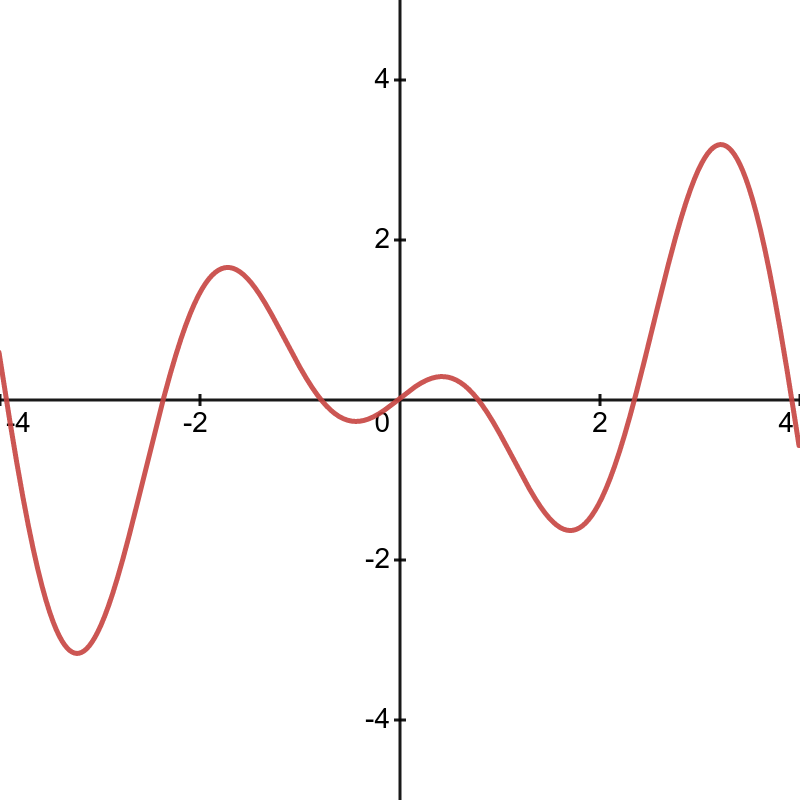
Let’s sketch the derivative of
Solution
See Desmos.
We’ll discuss any questions you have, model the first problem from the next activity, and then head back to the board for more practice.
Activity - Practice with the Chain rule.
For each pair of functions \(f(x)\) and \(g(x)\) below, write out the compositions \(f(g(x))\) and \(g(f(x))\). Then compute the derivative of each composite function. Remember to pass the chalk between each problem.
\(f(x) = 3x + 4\), \(g(x) = x^2 + 1\)
\(f(x) = e^x\), \(g(x) = \sqrt{2x-5}\)
\(f(x) = \frac{1}{x}\), \(g(x) = 2\ln(x)\)
\(f(x) = (x-5)^4\), \(g(x) = \sqrt[3]{x^2}\)
\(f(x) = e^{3x}\), \(g(x) = x^4 - 1\)
\(f(x) = \frac{x}{x-3}\), \(g(x) = \ln(5x)\)
\(f(x) = 2x^3 - 10x^2 + 2x\), \(g(x) = \sqrt{\frac{x-4}{2}}\)
\(f(x) = \frac{1}{x^5}\), \(g(x) = 4e^x\)
\(f(x) = \sqrt{8-x}\), \(g(x) = (2x-1)(x+5)\)
\(f(x) = e^{x/2}\), \(g(x) = 5x^3\)
\(f(x) = 1 - \frac{3}{x^4}\), \(g(x) = 2 - \sqrt{x}\)
\(f(x) = \frac{3}{x^2}\), \(g(x) = \ln(x)\)
\(f(x) = 27 - x^3\), \(g(x) = x^2 - x - 12\)
\(f(x) = \sqrt[3]{4-x^2}\), \(g(x) = 5x + 7\)
\(f(x) = \frac{x+1}{x-2}\), \(g(x) = e^{-x}\)
Source: Class.21 on byuimath.com